
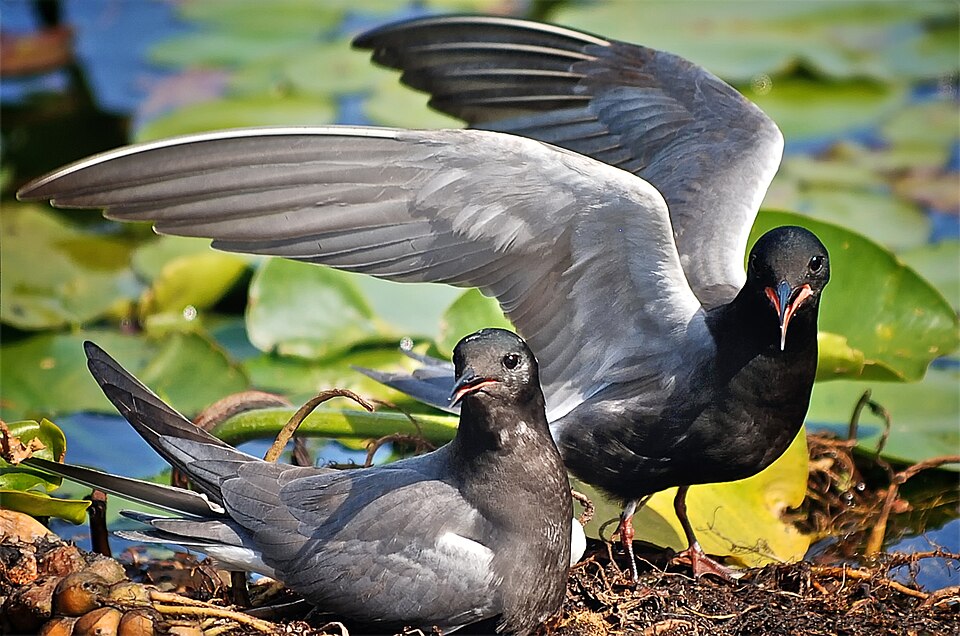
The Black Tern (Chlidonias niger) is a small, dark tern that breeds in inland freshwater marshes and sloughs. It is best identified by its buoyant, erratic flight, frequent hovering above the water, and a distinctive black hood with a white face in breeding plumage. Unlike many other terns, it does not dive for fish but instead picks insects and small prey from the surface or vegetation.
Learn to identify
Breeding adult Black Tern of the North American race, photographed in Grasslands National Park, Saskatchewan.
Learning lesson · openly licensed photographs, labelled by BirdBot; labels checked against the cited sources and approved by AI

Silvery gray wings: gray back and wings above the black body. Black head: black head and neck in breeding plumage. Black underparts: breast and belly black in summer. Winter birds lose the black body but stay darker-backed than other small terns.
Late-summer birds moulting out of breeding plumage look patchy black and white.
Sources: Audubon Guide to North American Birds: Black Tern · Wikipedia: Black tern (revision 1386471464)
Photo: Cephas, CC BY-SA 4.0, via Wikimedia Commons; labels added by BirdBot.
Adult Black Terns measure approximately 25 cm (10 in) in length with a wingspan of 61 cm (24 in) and weigh about 62 g. They possess a short, slender, black bill that is nearly as long as the head and appears slightly decurved. The legs are short and dark.
In breeding season, the bird displays a striking contrast: a black head, neck, and belly, with a dark grey back and white forewing. The face is white, interrupted by a large, dark triangular patch in front of the eye. The black cap unites with the ear coverts to form an almost complete hood. The tail is light brownish-grey and square-tipped. Juveniles may show a broadish white collar and greyish-brown smudges on the white breast.
Outside the breeding season, most of the black plumage is replaced by grey, leaving only the cap black. The upperparts become drab with pale feather-edgings, and the rump is brownish-grey. This muted appearance makes the bird harder to distinguish from other dark terns at a distance, but the flight style remains a key identifier.
The Black Tern is a gregarious species that often nests in colonies and gathers in large flocks during migration. Its flight is described as buoyant and erratic. A critical field cue is its tendency to hover above marshes. When feeding, the bird circles low with slow, shallow wingbeats and its bill pointed down. It may hover briefly before making a sudden drop or swoop to the surface, dipping its bill into the water or picking insects off vegetation. It has even been recorded chasing minnows cast by fishermen.
Black Terns breed in inland freshwater marshes and sloughs with dense vegetation, such as cattails, and pockets of shallow open water. These wetlands are often found in temperate regions of Canada, the northern United States, Europe, and western Asia. During winter, the birds migrate to coastal areas, including the coasts of South America, western Africa, and the Pacific and Caribbean coasts of Mexico. In North America, they are primarily birds of the interior during the breeding season but appear in considerable numbers on the South Atlantic and Gulf coasts during periodic migrations.
The diet of the Black Tern shifts with the season. During breeding, it consumes insects (such as damselflies and dragonflies), small freshwater fish, grubs, larvae, and small mollusks. The average fish taken during this period is small, typically 2.5 to 3.0 cm in length. Outside the breeding season, the diet consists mainly of small marine fish, such as anchovies and silversides, as well as plankton. Unlike the "white" Sterna terns, Black Terns do not dive for fish; they forage on the wing, picking items at or near the water's surface or catching insects in flight.
Black Terns nest in small colonies in upland marshes and sloughs. Nests are typically built on muskrat houses or floating masses of dead plants, usually over water 4 to 34 inches deep. The courtship ritual is elaborate, involving much flying, with males often carrying fish in their mouths to attract females. The typical clutch size is 2–4 eggs, with 3 being common. Eggs are laid from May to early August, and incubation lasts approximately 22 days. Hatching success is often low due to predation and disturbance. Chicks leave the nest very early, often swimming before they can fly, which occurs within about 24 days. Black Terns do not breed until they are fully mature at two years of age.
The Black Tern produces a high-pitched "kik" call. In large flocks, the combined noise can be deafening. This intensity was notably described by Thomas Pennant in his 1769 account of vast flocks in Lincolnshire, where he wrote that they "almost deafen one with their clamors."
The Black Tern is listed as Least Concern (LC) in the AviList v2026 checklist. While not globally threatened, the species is sensitive to habitat loss. Historical records indicate that extensive drainage of breeding grounds, such as in the English Fens, led to local population declines. Current population trends are not detailed in the provided sources; for the most up-to-date data, consult the BirdLife Species Factsheet.
Observing Black Terns requires patience and respect for their sensitive breeding habitats. Look for them in dense marshes during the summer months. Watch for the distinctive hovering flight and sudden dips to the water surface. Because parents aggressively defend their nests, often swooping and striking at intruders, it is crucial to maintain a significant distance. Use binoculars or a telephoto lens to observe behavior without causing disturbance. Avoid approaching active colonies, as human presence can lead to nest abandonment or increased predation.


