
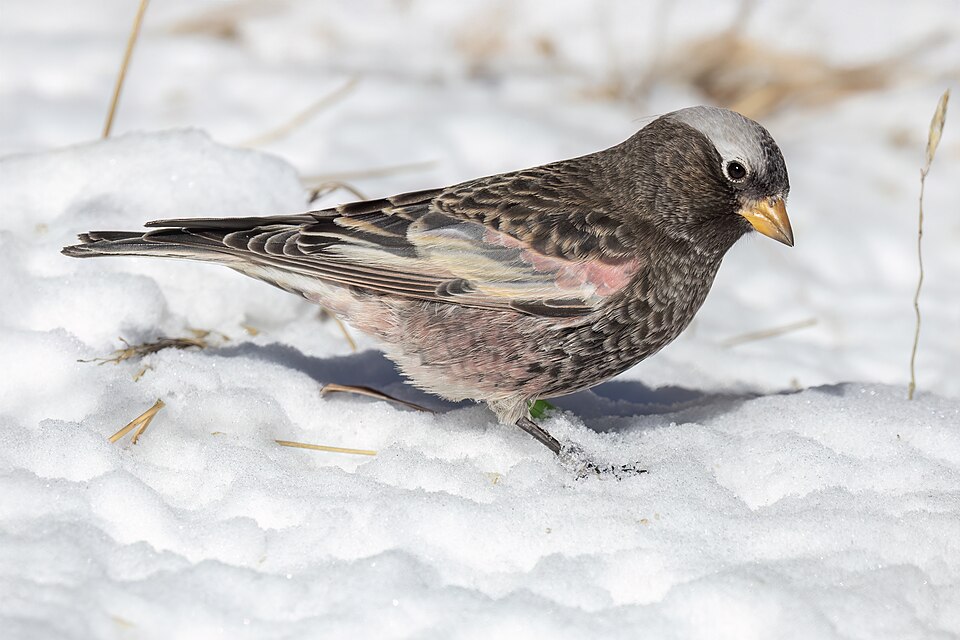
The Black Rosy Finch (Leucosticte atrata) is a small alpine finch native to the western United States, characterized by black heads, backs, and breasts contrasted with pink bellies, rumps, and wings, and a distinctive grey nape patch. It breeds above treeline in rocky cliffs and is currently listed as Endangered.
Learn to identify
Adult Black Rosy Finch in winter, photographed at Sandia Crest, New Mexico.
Learning lesson · openly licensed photographs, labelled by BirdBot; labels checked against the cited sources and approved by AI

Gray head patch: a gray band across the back of the head. Rosy wing patch: rosy patches on the wing. Blackish breast and back: black head, back and breast in adults. Pink belly: a rosy wash on the belly. Gray-crowned Rosy-Finch has a brown body, not a black one.
Females are plainer; the bill is yellow in winter, black in summer.
Sources: Audubon Guide to North American Birds: Black Rosy-Finch · Wikipedia: Black rosy finch (revision 1380656324)
Photo: Polinova, CC BY-SA 4.0, via Wikimedia Commons; labels added by BirdBot.
Adults of this species present a striking two-tone pattern. The head, back, and breast are black, while the belly, rump, and wings display a rosy pink hue. A key diagnostic feature is the patch of grey at the back of the head (nape). They possess short black legs and a long, forked tail. This plumage distinguishes them from similar species in the genus Leucosticte.
Because the Black Rosy Finch is the most range-restricted member of its genus, confusion can occur where ranges overlap or in mixed flocks. Use the following key field marks to separate it from its congeners:
Note that the Black Rosy Finch is located between the ranges of these two species, with the Grey-crowned to the north and west, and the Brown-capped to the south and east.
The breeding habitat of the Black Rosy Finch is strictly alpine, found in mountain areas above the tree-line amongst rocks and cliffs. According to AviList v2026, the species breeds in the mountains of Idaho and Montana to Nevada and Utah, and winters as far south as Arizona. Most individuals migrate short distances to lower elevations and further south during the non-breeding season, returning to the alpine areas in April.
For birders targeting this species, focus on high-elevation alpine zones in the following regions:
These birds forage on the ground, often in small flocks, sometimes mixing with Grey-crowned Rosy Finches. They feed primarily on seeds from weeds and grasses, as well as insects, which they may catch in flight. A notable foraging behavior occurs in areas where snow is melting, as this process uncovers food items and new plant shoots. During the breeding season, males defend their female's territory, not just the nest site but wherever she goes. A unique physiological adaptation is the development of throat pouches, known as gular pouches or gular skin, in both males and females during breeding. These pouches are used to carry food to their chicks, a trait shared with only one other North American genus, Pinicola.
Black Rosy Finches build cup nests in cavities on cliffs. The nests are constructed from grass and stems and lined with fine grass, hair, and feathers. They are known to use protected areas such as openings in cliffs, mine shafts, caves, and rafters. Due to the inaccessibility of these sites, actual nests had been reached by only three researchers as of 2002, making this species one of the least studied birds in North America. This scarcity of direct observation data is a primary reason for its limited scientific profile.
The Black Rosy Finch is classified as Endangered (EN) in the AviList v2026 checklist. The paucity of definitive information about its breeding distribution has led conservation bodies, such as the Wildlife Action Plan Joint Team of the Utah Division of Wildlife Resources, to designate it a "species of greatest conservation need" in Utah. Its restricted range and inaccessible nesting sites contribute to the difficulty in assessing its population trends.
Observing Black Rosy Finches requires patience and respect for their fragile alpine habitat. The best approach is to observe from a distance in alpine rock fields where snow is melting, as the birds forage on the ground in these areas. Look for small flocks of black-and-pink birds with grey napes. Avoid approaching cliff faces or nest sites, as disturbance can be detrimental to breeding success. Listening for their buzz-sounding "chew" call can also help locate them when they are obscured by rocks.


