
The Black-headed Grosbeak (Pheucticus melanocephalus) is a medium-sized songbird in the cardinal family, recognized by its large, conical, straw-colored bill and rich, robin-like song. Natural history details in this guide are drawn from the Animal Diversity Web (ADW) and AviList v2026; local field conditions, abundance, and seasonal timing may vary by region.
Learn to identify
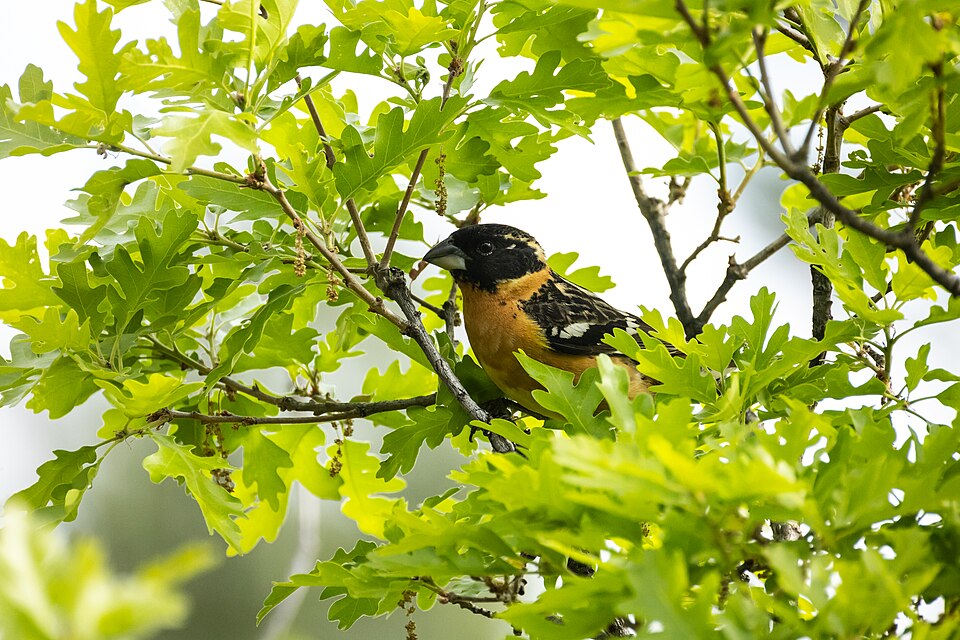
Male Black-headed Grosbeak in an oak in spring, photographed in Colorado.
Learning lesson · openly licensed photographs, labelled by BirdBot; labels checked against the cited sources and approved by AI

Black head: the mark the species is named for. Black-and-white wings: black wings and tail with bold white patches. Orange-brown breast: dark to tawny orange; the belly is yellow. Black head plus orange breast: a male.
Females are brown and streaked, with white head stripes.
Sources: Audubon Guide to North American Birds: Black-headed Grosbeak · Wikipedia: Black-headed grosbeak (revision 1352290768)
Photo: mark byzewski, CC BY 2.0, via Wikimedia Commons; labels added by BirdBot.
Field identification of the Black-headed Grosbeak relies heavily on the distinctive bill and sexual dimorphism. Both sexes possess a large, conical, thick, and straw-colored bill, a trait that gives the group its common name. The species measures 15 to 20 cm in length, with a wingspan of 30 to 33 cm and a weight range of 38 to 54 grams.
Males are more colorful, featuring a black head, bright orangish-brown underparts, white patches on the wings, and a black-and-white tail. They also have red legs. Females are more subdued, with brown to dark grey feathers, a striped head, back, and sides, a paler bill, a white wing bar, and a tan breast. Both genders have yellow wing linings, which can be a helpful flash of color in flight.
The song of the Black-headed Grosbeak is one of its most reliable field marks. It is described as rich and clear, containing whistled notes, trills, and a back-and-forth warble. The song closely resembles that of its close relative, the Rose-breasted Grosbeak, and is often compared to the songs of a robin or western tanager, but with a richer quality.
Males sing primarily to declare territory and attract females. Females also use song, often while foraging, to communicate with other females, or to maintain contact with their offspring. The species also relies on visual cues for communication, such as assessing mates and responding to young.
Black-headed Grosbeaks prefer deciduous and broad-leaved evergreen woods. They are often found nesting in thickets on the edges of open woods, ponds, swamps, or streams, or in small trees. This edge habitat provides both cover for nesting and open areas for foraging.
According to AviList v2026, the breeding range extends from southern Alaska and southern British Columbia to southwestern Saskatchewan, southward to central Mexico (Guerrero and Oaxaca), westward to the Pacific Coast (including northern Baja California), and eastward to central North Dakota to southwestern Texas, western Coahuila, central Puebla, and Oaxaca. The non-breeding range is primarily in Mexico, along the Pacific slope from southern Sonora to Michoacán, in the interior from Zacatecas to Oaxaca, and less commonly on the Atlantic slope from Tamaulipas to Oaxaca, and in southern Baja California.
These birds are diurnal, active during the day and resting at night. Their flight pattern is distinctive, characterized by short, rapid wing beats. Black-headed Grosbeaks are migratory, moving between summer breeding ranges and wintering ranges yearly.
During the breeding season, they are relatively aggressive toward conspecifics. Both males and females will fight with other grosbeaks of the same sex over territory or to protect eggs. Outside of the breeding season, they occur in small, loose flocks. Individual territories during breeding range from 7,900 to 27,000 square meters.
Black-headed Grosbeaks are monogamous. Males arrive in the spring about six days before the females, remaining solitary until the females arrive. Males sing to establish territory and attract mates, and older males tend to secure higher-quality territories. Fighting for territory can be aggressive, with swift attacks during flight.
Females build a loose nest of twigs, rootlets, and other plant materials between 4 and 25 feet above the ground, usually in deciduous trees such as willows and coast live oaks, or in shrubs bordering streams. The nest is placed in the dense outer foliage near an opening. Construction takes 3 to 4 days. The species produces one brood per year, from April to July, laying 2 to 5 eggs. Incubation lasts 12 to 13 days, with both sexes sharing the duty. Young fledge after about 12 days and become independent after another 14 days.
During the breeding season, Black-headed Grosbeaks prey mainly on insects and other invertebrates, including spiders, beetles, scale insects, flies, wasps, bees, grasshoppers, codling moth caterpillars, and cankerworms. They also eat small fruits such as cherries, blackberries, raspberries, strawberries, elderberries, and mistletoe berries, as well as buds and seeds, which they crack open with their large, sturdy bill.
They forage in trees and shrubs, predominantly by gleaning. They are known to come readily to feeding stations and campgrounds. Their winter diet is mostly unknown.
The Black-headed Grosbeak is listed as Least Concern (LC) in the IUCN Red List as recorded in AviList v2026. This status indicates that the species is not currently facing a high risk of extinction in the wild. The species is protected under the United States Migratory Bird Treaty Act. Note that this is a global assessment and does not reflect local abundance or population trends.
Black-headed Grosbeaks breed across western North America, from southern Alaska and British Columbia south to central Mexico and east to the Dakotas and Texas (AviList v2026). In the field, target deciduous and broad-leaved evergreen woods, particularly thickets on the edges of open woods, ponds, swamps, or streams. In the Rocky Mountains, historical records note they were common summer residents from the plains up to 8,500 feet (Keyser, 1902), though current local densities vary.
For a concrete observation cue, listen in early spring for males singing from perches. A key behavior to watch for is the male flying up into the air while singing a courtship song, a display used to attract females after they arrive on the territory. Their rich, robin-like whistles and trills are often heard before the birds are seen. When observing, maintain a respectful distance to avoid disturbing nesting birds. Do not approach nests or feed birds in a way that causes stress. If you are using a camera, ensure it is set up to minimize disturbance and that you are following local regulations and ethical guidelines for wildlife photography.


