
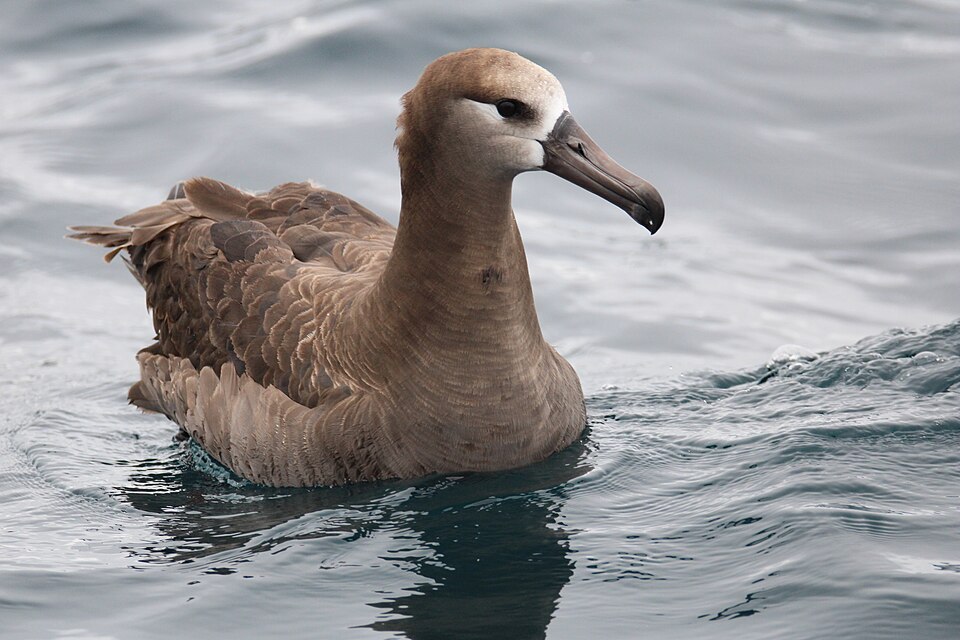
The Black-footed Albatross (Phoebastria nigripes) is a large, dark-plumaged seabird in the order Procellariiformes and family Diomedeidae. It is one of only three albatross species that range in the Northern Hemisphere, breeding primarily on the isolated islands of the Northwestern Hawaiian chain. In the field, it is distinguished by its all-dark body, white markings around the base of the bill and below the eye, and a dark bill and feet.
Learn to identify
Adult Black-footed Albatross of the North Pacific, photographed on Midway Atoll.
Learning lesson · openly licensed photographs, labelled by BirdBot; labels checked against the cited sources and approved by AI

White bill base: white around the bill and below the eye. Dark bill: the bill is dark; so are the feet. Dusky brown plumage: dark brown to blackish nearly all over. White undertail: some adults show white at the tail base. Unlike many albatrosses, it is dark all over.
Older birds show more white at the bill base; sexes look alike.
Sources: Audubon Guide to North American Birds: Black-footed Albatross · Wikipedia: Black-footed albatross (revision 1360535103)
Photo: kris krüg from Vancouver, Canada, CC BY-SA 2.0, via Wikimedia Commons; labels added by BirdBot.
The Black-footed Albatross is a small member of the albatross family, though still large compared to most other seabirds. Adults measure 68 to 74 cm (27–29 in) in length, with a wingspan of 190 to 220 cm (6.2–7.2 ft) and a weight of 2.6–4.3 kg (5.7–9.5 lb). Males are slightly larger, averaging 3.4 kg (7.5 lb), compared to females at 3 kg (6.6 lb). The plumage is almost entirely black or dark grey, with no seasonal variation. A key field mark is the white feathers near the base of the bill and on the underside of the tail; as birds age, they acquire more white at the bill base. The bill and feet are entirely dark.
Comparison with Laysan Albatross: The Black-footed Albatross is frequently confused with the Laysan Albatross (Phoebastria immutabilis), which shares its breeding range in the Northwestern Hawaiian Islands. The most reliable field distinction is the bill and feet: the Black-footed has a dark bill and dark feet, whereas the Laysan has a pale bill and yellowish feet. Additionally, the Laysan is predominantly white with black markings, contrasting sharply with the Black-footed’s all-dark plumage.
This species prefers vast open water and sandy beaches on islands for breeding. Approximately 97.5% of the population breeds colonially on the isolated Northwestern Hawaiian Islands, from Kure Atoll to Kaʻula Island, including sites like Laysan, Midway, and the French Frigate Shoals. Small populations exist on Japanese islands (Tori Shima, Bonin, Senkaku) and off the Mexican coast (Isla Guadalupe). At sea, the species ranges across the North Pacific from Alaska to California and Japan, with a preference for the northeastern Pacific. It is extirpated from several other Pacific islands, including Iwo Jima and Wake Island. The Black-footed Albatross overlaps greatly in breeding and feeding range with the other two species of northern albatross, although the Laysan and Short-tailed Albatrosses range further north into the Bering Sea than the Black-footed will.
Black-footed Albatrosses are sociable and curious, even as nestlings, which may wander and pick up small objects. Adults forage alone at night and are most active in the early morning, while gathering in groups on the water's surface during the day. On land, they are shy and nervous, and may attack humans if harassed. The species forms lifelong pair bonds; birds return to the colony after three years and spend two years courting before reproducing, which begins around age seven. They mate every two years.
Nesting occurs on exposed sandy beaches, often in colonies with other pelagic birds. Males arrive about 20 days before females to build simple depressions in the sand and reclaim territory. The pair lays a single egg, which is dull white with reddish-brown spots. Incubation lasts 65 days, with both parents sharing duties. The chick is brooded for 20 days, then fed regurgitated food by its parents. Fledging occurs after 140 days. If an egg is lost, no replacement is laid, and the pair waits until the next year to renest.
Feeding occurs in pelagic waters. The diet consists mainly of fish, fish eggs (particularly from flying fish), squid, and crustaceans. The species is also known to consume floating debris, including plastics, a behavior that poses conservation risks. Historically, they have been called the "feathered pig" for their willingness to eat edible refuse, including galley garbage.
The Black-footed Albatross is listed as Near Threatened (NT) in the AviList v2026 checklist. A primary threat is bycatch in fishing gear; a 1996 US Fish and Wildlife Service estimate indicated that 2,000 individuals were killed annually by fishermen's lines. Given the species' late sexual maturity (around 7-9 years) and low reproductive rate (one egg every two years), such losses can have a substantial impact on population stability. Whole-genome analyses suggest the species has experienced significant population fluctuations and currently has very low genetic diversity. A 2023 study of North Pacific albatrosses found that the abundance of the black-footed albatross dropped again during the Last Glacial Maximum, potentially linked to climate-driven loss of breeding sites and concordant genome-derived decreases in its major prey.
Most observations of the Black-footed Albatross occur from boats in the North Pacific, where the species forages in pelagic waters. When at sea, use binoculars to identify the dark plumage and white bill-base markings without disturbing the birds. If you have the opportunity to visit a breeding colony on the Hawaiian islands, observe from a distance. Black-footed Albatrosses are shy and nervous on land and may attack humans if harassed; keeping a respectful distance prevents stress that can lead to nest abandonment or increased aggression. A practical field exercise is to observe the species during early morning hours, when they are most active, and practice distinguishing the dark bill and feet from the pale bill and yellowish feet of the Laysan Albatross.


