

Audubon's Oriole (Icterus graduacauda) is a medium-sized, yellow-bodied oriole distinguished by a fully black hood, a black graduated tail, and white wing bars. It inhabits the edges of dense woodlands and riparian areas in south-central Texas and Mexico, preferring elevations above 500 m. The species is currently listed as Least Concern (LC) in the AviList v2026 taxonomy.
Learn to identify
Adult Audubon's Oriole, photographed at Salineño, south Texas.
Learning lesson · openly licensed photographs, labelled by BirdBot; labels checked against the cited sources and approved by AI
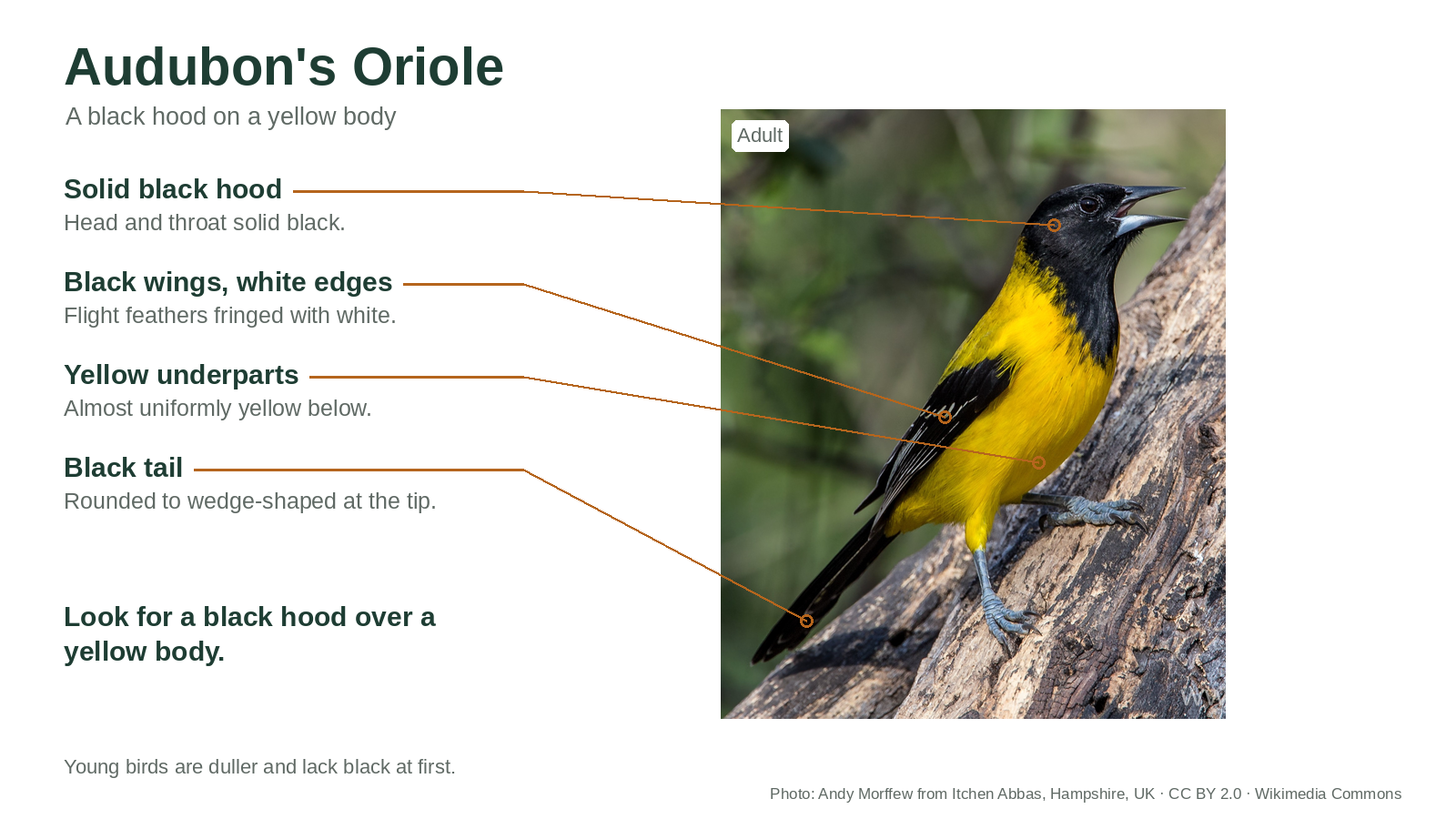
Solid black hood: head and throat solid black. Black wings, white edges: flight feathers fringed with white. Yellow underparts: almost uniformly yellow below. Black tail: rounded to wedge-shaped at the tip. Look for a black hood over a yellow body.
Young birds are duller and lack black at first.
Sources: Audubon Guide to North American Birds: Audubon's Oriole · Wikipedia: Audubon's oriole (revision 1348814711)
Photo: Andy Morffew from Itchen Abbas, Hampshire, UK, CC BY 2.0, via Wikimedia Commons; labels added by BirdBot.
The defining field mark is the fully black hood, which makes Audubon's Oriole the only yellow-bodied oriole in the New World with this feature. The tail is black, long, narrow, and obviously graduated, with olive-tipped feathers creating a distinct stepped appearance. The culmen is stout, black, and straight, a reliable diagnostic feature when the bird is in profile.
Adults are nearly monomorphic, though males are slightly larger and brighter. The body is generally yellow, with underparts brighter than the greenish-yellow back and nape. In adult males, the wings and tail are black, with white-fringed greater coverts forming a distinct wing bar. The median and lesser coverts form yellow epaulets. In flight, the white-fringed remiges and retrices contrast sharply with the black wings and tail.
Females are duller, with an olive-green wash on the back and wings. Juveniles have a pink lower mandible, a greenish-gray face, and yellow-tipped gray wings. Immature individuals resemble females but have duller wings and greener upperparts.
Three other orioles share similar plumage: Scott's Oriole (Icterus parisorum), Greater Antillean Oriole (Icterus dominicensis), and Black-cowled Oriole (Icterus prosthemelas). Scott's Oriole is distinguished by more prominent wing bars and yellow-fringed retrices. The Black-cowled and Greater Antillean Orioles lack wing bars entirely.
This tropical species prefers the edges of dense, established woodlands and riparian areas. It is found in scrubland, cloud forest, and both deciduous and evergreen forests. Audubon's Orioles are rarely seen in open fields or urban areas, though they may visit suburban feeding stations in winter. They occur at elevations up to 2,500 m but avoid areas below 500 m. The range extends from south-central Texas to central Veracruz and from Nayarit to Oaxaca on the Pacific slope. On the Pacific slope, look for them in cloud forest edges from Nayarit to Oaxaca.
Audubon's Orioles are usually seen alone or in pairs, with mated pairs often foraging together. During winter, they may join mixed-species flocks containing green jays, tanagers, and other orioles. Small conspecific flocks of eight to ten individuals are occasionally observed. The species is territorial during the breeding season but does not exhibit this behavior in winter.
The song is described as a low, mellow, humanlike whistle consisting of non-repeating notes with little frequency modulation. Both sexes sing, and mated pairs often answer each other, possibly to reinforce pair bonding or defend territory. Alarm calls are nasal, described as a "nyyyee," with the interval between repetitions decreasing as the bird becomes more excited. The species is generally less vocal than North American Icterus species.
Primarily insectivorous, Audubon's Orioles consume beetles, butterflies, and spiders. They also eat orchard fruit (plums, peaches, apples), hackberries, sunflower seeds, and mesquite beans. They occasionally visit suburban hummingbird and seed feeders.
Nests are semi-pensile (dangling) and cup-shaped, built close to the trunk of large trees rather than on smaller branches. In most areas, nests are placed 12.9 to 33 m above the ground, though in Texas, they prefer mesquite trees at lower heights (1.8 to 4.3 m). Nests are constructed from fine plant fibers, primarily palmetto leaf strands. Only the female incubates the eggs, but both parents feed and protect the young. Fledging occurs approximately eleven days after hatching.
Audubon's Oriole is listed as Least Concern (LC) in the AviList v2026 taxonomy. Historical records indicate a marked population decline in southern Texas due to nest parasitism by bronzed cowbirds and habitat clearing for human development. According to ADW accounts, the species is also sensitive to human interference during the breeding season.
Observe Audubon's Orioles quietly from a distance, particularly in woodland edges where they are most common. Avoid disturbing them during the breeding season, as they are sensitive to human interference. Look for the distinctive black hood and graduated tail in the canopy or mid-story of dense woodlands.
Next Action: Visit riparian woodland edges in south-central Texas during the breeding season (wet season) when pairs are active and singing to defend territory.


