
Anna's Hummingbird (Calypte anna) is a small hummingbird found along the Pacific coast of North America, from southwestern Alaska to northern Mexico. Adult males are distinguished by their iridescent rose-pink throat and crown, while both sexes feed on nectar and insects by hovering before flowers. A key field mark is the male's courtship dive, which ends in a loud squeak produced by fluttering tail feathers rather than the syrinx.
Learn to identify
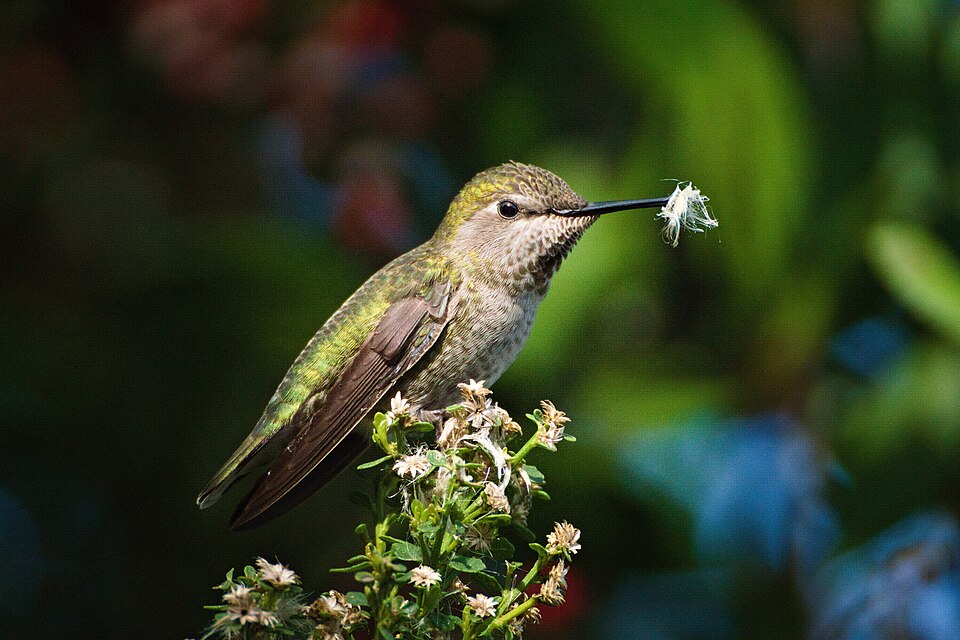
Adult male Anna's Hummingbird perched in side view (Commons photo by Nigel).
Learning lesson · openly licensed photographs, labelled by BirdBot; labels checked against the cited sources and approved by AI

Long, straight bill: slender and straight. Rose-red gorget: crown and throat are rose-red but can look black in some light. Gray chest: pale gray below, with green on the flanks. Green back: iridescent bronze-green above. The male is the only North American hummingbird with a red crown.
Females are green above and gray below, often with red throat spots.
Sources: Audubon Guide to North American Birds: Anna's Hummingbird · Wikipedia: Anna's hummingbird (revision 1379926079)
Photo: Nigel, CC BY 2.0, via Wikimedia Commons; labels added by BirdBot.
Identifying Anna's Hummingbirds relies heavily on plumage and behavior, as they are often seen in quick flashes near feeders or blossoms. Adult males display a striking rose-pink throat and crown, which can appear metallic in certain lights. This coloration is the primary visual cue for sexing the bird in the field. Females and immature males lack this vibrant gorget and crown, appearing more subdued, though specific plumage details for females are not detailed in the current verified profile. Because the bird is small and fast, observing the male's display behavior is often more reliable than catching a static look at the plumage.
One of the most distinctive features of the male Anna's Hummingbird is the sound it makes during its courtship display. While many birds produce sounds via their syrinx, the loud squeak at the bottom of the male's dive is generated mechanically. High-speed video analysis has shown that this sound is produced by the fluttering of the trailing vane of the outermost tail feathers. This aerodynamic sonation is a unique adaptation that allows the male to produce a sharp, attention-grabbing signal during the rapid descent of his display dive.
Anna's Hummingbirds are active foragers that hover before flowers to extract nectar and capture insects. This hovering behavior is a hallmark of the family Trochilidae. In addition to foraging, males are territorial and perform elaborate courtship dives. These displays involve a steep dive followed by a sharp turn upward, culminating in the characteristic tail squeak. Only females care for the young, a pattern common among hummingbirds where the male's role is primarily limited to territorial defense and courtship.
Anna's Hummingbirds breed from southwestern Alaska to northwestern Baja California and winter in northern Mexico. They are often found in habitats with abundant flowering plants, including eucalyptus trees and cultivated gardens. Their presence in urban and suburban areas is well-documented, particularly where garden flowers provide a reliable food source.
Females construct nests using plant down and spider webs. Only the female incubates the eggs and cares for the chicks. The male does not participate in nest building or chick-rearing, focusing instead on defending his territory and displaying to attract mates.
The common call of the Anna's Hummingbird is a series of short, sharp chip notes. These chips are produced by both sexes in various contexts, including territorial disputes and foraging. In addition to the chip notes, displaying males produce the loud squeak associated with their courtship dive. This squeak is distinct from the chip notes and is a key auditory cue for identifying the species in the field, especially when the bird is in motion.
Anna's Hummingbirds are listed as Least Concern (LC) in the AviList v2026 checklist. This status reflects their wide range and stable population. However, local populations can be affected by habitat loss and changes in flowering plant availability. Community science efforts, such as those supported by BirdBot, help track local abundance and distribution, providing valuable data for conservation monitoring.
To observe Anna's Hummingbirds ethically, maintain a respectful distance and avoid disturbing their foraging or nesting activities. Use binoculars or a camera with a zoom lens to get a closer look without approaching too closely. Avoid using playback to lure birds, as this can stress them and disrupt natural behaviors. Focus on quiet observation and note the time of day, weather, and habitat conditions to contribute useful data to community science platforms.


