
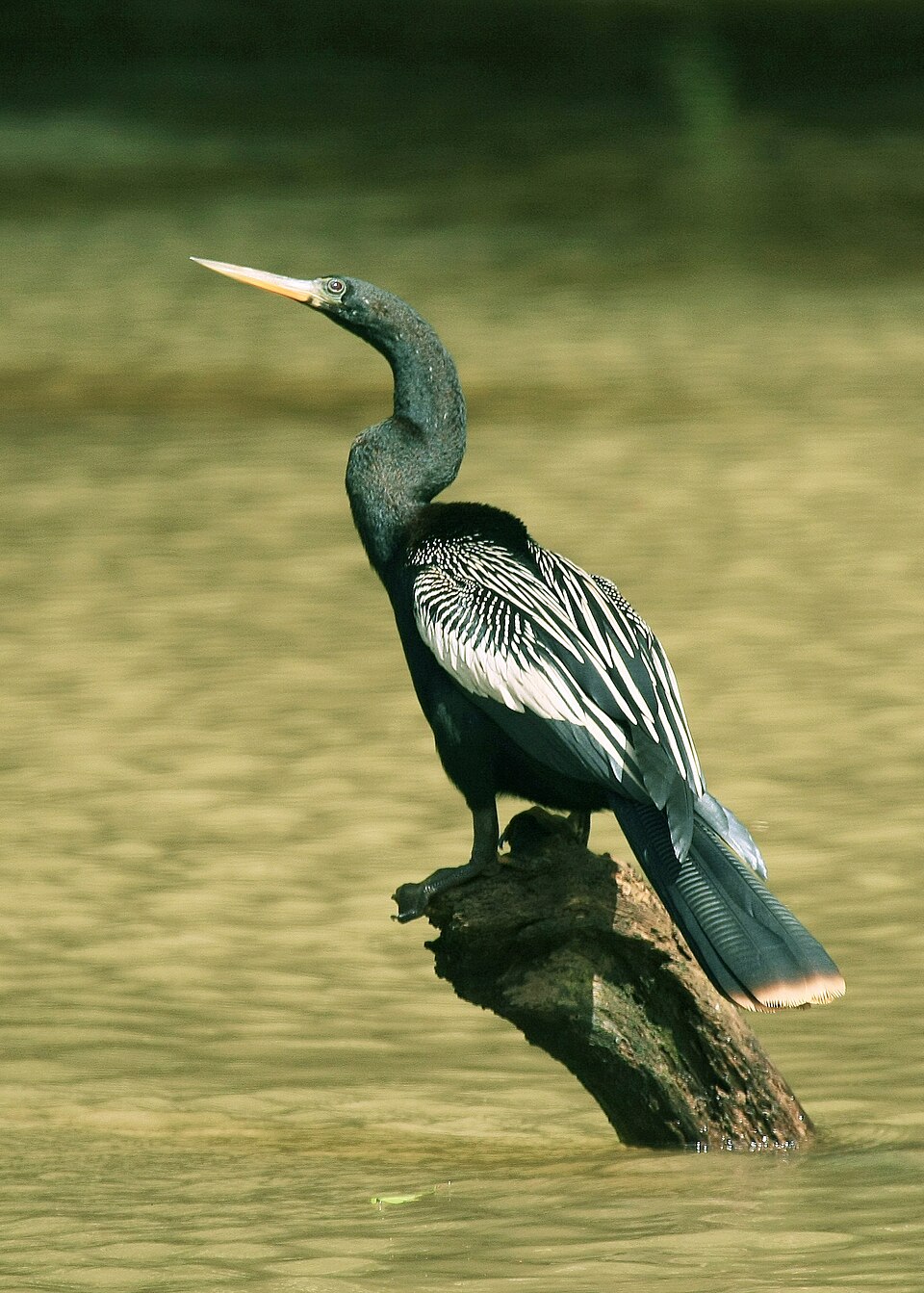
The Anhinga (Anhinga anhinga) is a freshwater and coastal aquatic bird in the order Suliformes and family Anhingidae. Distinguished by its long, snake-like neck and sharp, serrated bill, it hunts by stalking fish underwater and then perches in trees to sun-dry its wings. Males are glossy greenish-black with white plumes, while females are brown with lighter heads.
Learn to identify
Adult male Anhinga perched on a snag in Costa Rica.
Learning lesson · openly licensed photographs, labelled by BirdBot; labels checked against the cited sources and approved by AI

Dagger-pointed bill: long, narrow, yellow, and not hooked. Glossy black neck: glossy black-green in males. White wing markings: bold white spots and streaks above. Long, fan-shaped tail: with a pale tip. Unlike a cormorant: straight dagger bill and long fanned tail.
Females have a buff head, neck and chest.
Sources: Audubon Guide to North American Birds: Anhinga · Wikipedia: Anhinga (revision 1376211757)
Photo: Tim from Ithaca, CC BY 2.0, via Wikimedia Commons; labels added by BirdBot.
Anhingas are sexually dimorphic, making sex identification straightforward in adults. Males display a glossy greenish-black plumage overall, with silver-gray feathers on the upper back and wings edged with long white plumes. They also possess black crests. Females are predominantly brown, with a lighter brown head and neck. Juveniles are a uniform brown color, lacking the distinct plumage of adults.
Both sexes share a small head that appears to be an extension of the long, snake-like neck. The bill is long, sharp, and serrated, an adaptation for gripping slippery prey. The overall body shape resembles that of a cormorant, but the hunting action of the head and neck is more similar to a heron.
Unlike many aquatic birds, Anhingas have body feathers that become completely wet upon contact with water. This lack of an insulating air layer allows them to dive more easily through the water but results in low buoyancy, rapid heat loss, and hindered flight. Consequently, only the head and neck are typically visible when the bird is swimming.
The neck contains a hinge-like apparatus at the 8th and 9th cervical vertebrae, enabling the quick, striking motion used to catch prey. This specialized structure allows the Anhinga to snap its head forward with speed, a key distinction from the more flexible neck movements of herons. The legs are webbed for swimming but structurally better suited for crawling out of water and climbing bushes and trees. The long tail provides lift, steering, braking, and balance in flight, resembling a turkey's tail when spread.
Anhingas are solitary birds, though they may occasionally be found among groups of herons, cormorants, ibises, or storks. They spend most of their time in the water fishing. Their hunting strategy involves stalking slower-moving fish underwater, using their quick necks and sharp bills to spear the prey. They then bring the fish above water and manipulate it to swallow it head first.
Because their feathers become waterlogged and they lose heat quickly, Anhingas must frequently perch in trees to dry their wings and absorb solar heat. They often crawl from the water to high perches, spreading their wings in a distinctive sun-drying posture similar to cormorants and turkey vultures. This behavior is a key field cue for identification.
Anhingas are monogamous and may reuse nests from year to year. The male initiates courtship by soaring and gliding, then marks a potential nest site with leafy twigs. The female builds a platform nest of sticks and leaves, usually on a branch overhanging water or in the open top of a tree. Males are highly territorial and defend their nesting areas aggressively, using wing-spreading displays and beak-snapping to deter rivals.
Both parents share incubation duties for 25 to 30 days. The female lays a clutch of two to six eggs, with an average of four. Chicks hatch naked and helpless, eventually growing white down on their bellies and dark down on their backs. They fledge at approximately six weeks and remain with their parents for several more weeks before becoming independent.
Anhingas are normally quiet birds. Their vocalizations include clicks, rattles, croaks, and grunts. Calls are most common near the nest, while flying, or while perching. They are particularly silent and elusive during the molting period when they are flightless.
Anhingas prefer freshwater and coastal aquatic habitats that include shrub or tree-covered islands or shores. Specific habitat types include lakes, marshes, swamps, mangrove swamps, shallow coastal bays, and lagoons. These environments provide the necessary cover for stalking prey and perching for sun-drying.
According to the AviList v2026 checklist, the current range extends from southeastern Texas to eastern North Carolina and Florida in the United States, west-central Mexico southward to Panama, Cuba, and the Cayman Islands, and northern South America including Trinidad and Tobago, southward to northern Argentina.
For historical context, Chester A. Reed (1916) recorded a narrower distribution, noting breeding north to the Carolinas and Illinois with wintering in the Gulf States. This 1916 data reflects historical observations and should be distinguished from the broader, current range documented in modern checklists.
The Anhinga is listed as Least Concern (LC) in the AviList v2026 checklist. In the Americas, the species is considered abundant, although its aquatic habitats face threats. Historical data indicates that DDT affected reproductive success, and the subsequent ban on this pesticide in North America has benefited populations breeding in the southern United States.
To observe Anhingas, target shallow, slow-moving freshwater marshes or swamps with overhanging trees. The most distinctive behavior to watch for is the sun-drying posture: a bird perched high in a tree with its wings spread wide. This behavior helps the bird dry its plumage and absorb heat to maintain body temperature after swimming.
Observe from a distance to avoid disturbing the bird, especially during nesting season when males are territorial. While Anhingas are normally quiet, listening for clicks or grunts near the nest can help locate them, though they are often silent and elusive, particularly when flightless during molting.
Explore related waterbirds in our guides: American White Pelican, American Bittern, and American Coot.


