
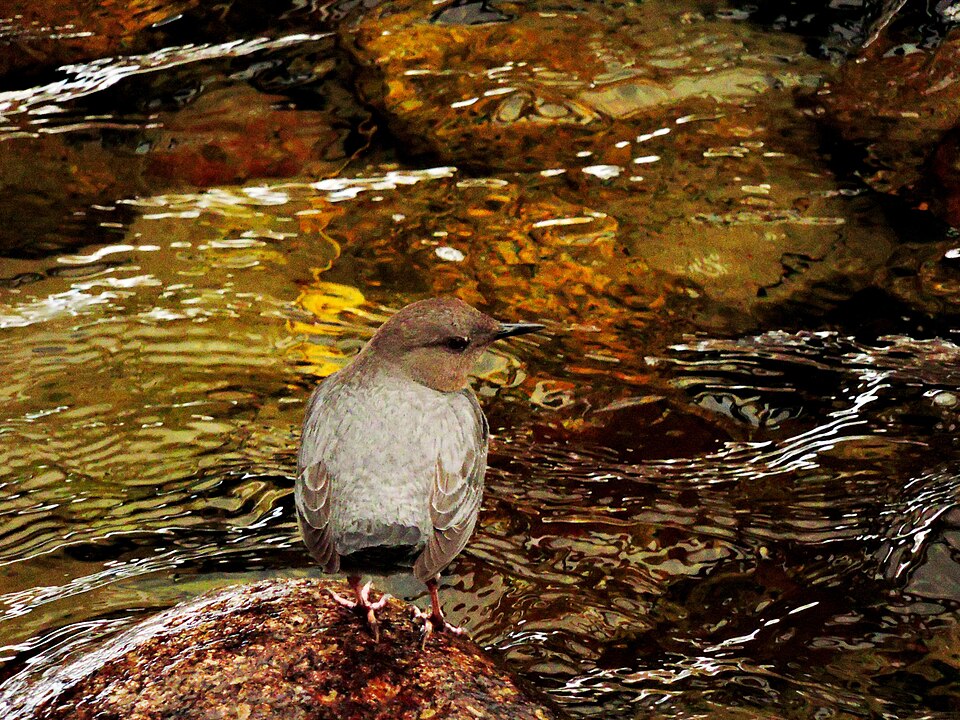
The American Dipper (Cinclus mexicanus) is a small, slate-grey songbird unique among North American songbirds for its ability to dive underwater to forage. It inhabits fast-flowing, cold streams from Alaska to Panama, where it walks stream bottoms and dives up to 20 feet deep. Identification relies on its aquatic habitat, yellow feet, and seasonal plumage shifts from spring's brown-headed adult to winter's white-edged plumage.
Learn to identify
Adult American Dipper foraging at the edge of the Blue River, Silverthorne, Colorado.
Learning lesson · openly licensed photographs, labelled by BirdBot; labels checked against the cited sources and approved by AI

Brown-tinged head: the head can be tinged brown. Dark bill: juveniles have a pale bill. Grey all over: chunky and plain slate grey. Chunky, short-tailed and plain grey, at the water's edge.
White eyelids flash when it blinks; juveniles show pale wing edgings.
Sources: Audubon Guide to North American Birds: American Dipper · Wikipedia: American dipper (revision 1380651543)
Photo: Ron Knight from Seaford, East Sussex, United Kingdom, CC BY 2.0, via Wikimedia Commons; labels added by BirdBot.
Identifying an American Dipper relies heavily on its distinct coloration and location. In the spring, adults display a slaty or deep neutral grey body, a brown head and neck, and darker grey to almost black wings and tail. A narrow border of white feathers touches the upper eyelids, and the bill is black. The feet are a bright yellow, a key field mark against the dark water and rocks.
During fall and winter, the plumage changes significantly. The underparts become margined with white, and the wings show white edging. The bill turns light brown. Young dippers are lighter on the stomach, with a nearly white throat and extensive white on the wing and tail feathers. Their bills are yellow, distinguishing them from the black-billed adults in spring.
Dippers prefer swift, clear, cold, permanent streams. They favor locations with large boulders, tumbling waterfalls, and steep cliffs or ledges that provide sheltered nesting sites, often directly under waterfalls. Man-made structures like culverts, bridges, and small dams are also utilized. Where streams flow into clear lakes or ponds, dippers forage along the edges.
Their range spans three major geographic regions:
Northern populations move to ice-free larger rivers during winter.
The dipper's most distinctive behavior is its aquatic foraging. It dives into the water or walks along the stream bottom to catch food. It can dive up to 20 feet underwater, aided by large oil glands that waterproof its feathers and nasal flaps that close its nostrils. Mating pairs aggressively defend their territories, driving away intruding dippers. Some dippers have been noted to wash food before feeding it to their young.
Nests are typically built under waterfalls, in rock crevices, or under man-made structures like culverts. The female lays four to five eggs, which are incubated for about 16 days. The young remain under parental care for 24 to 25 days after hatching.
The mating ritual involves the male stretching his neck upward with his bill vertical and wings partially spread. He struts and sings before the female. If the song is accepted, the pair performs together, ending the display with their breasts touching. This visual and vocal display is a key indicator of breeding activity.
Observe dippers quietly from a distance near fast-flowing streams. Watch for diving behavior or territorial displays without approaching nests. Because nests are often in damp, rocky crevices under waterfalls, they can be difficult to access and should not be disturbed. Look for the yellow feet and white eyelid borders in spring, and the white wing edging in winter. Listening for the strutting display and song during the breeding season can also confirm presence.


