
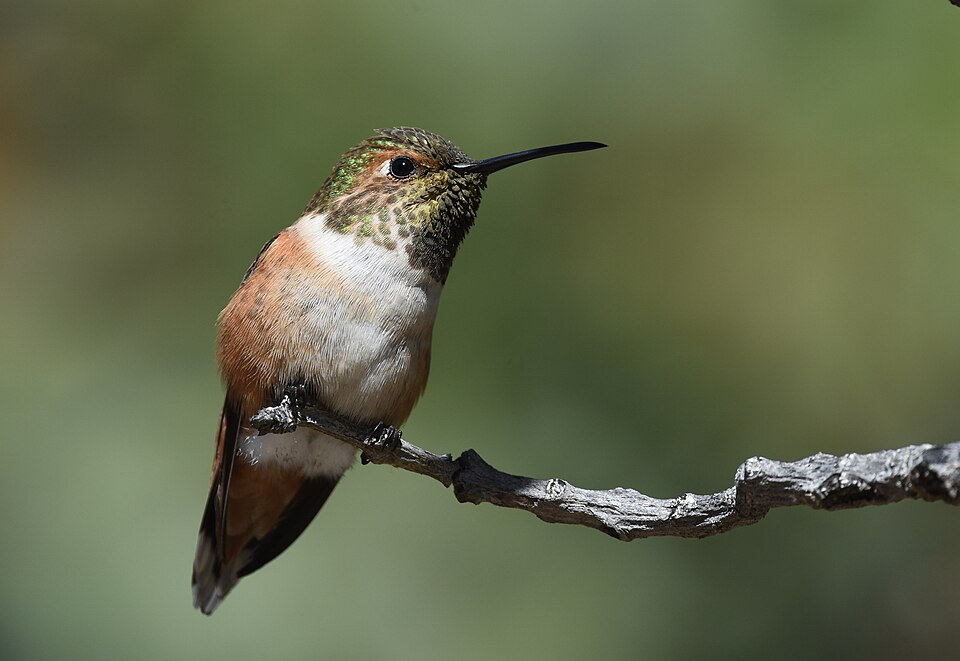
Allen's Hummingbird (Selasphorus sasin) is a small hummingbird found in coastal California and southern Oregon, distinguished by the male's iridescent orange-red throat and the unnotched second tail feather that separates it from the similar Rufous Hummingbird.
Learn to identify
Adult male Allen's Hummingbird, photographed in coastal California.
Learning lesson · openly licensed photographs, labelled by BirdBot; labels checked against the cited sources and approved by AI

Green cap: green on the top of the head. Orange-red throat: the male's iridescent gorget. Green back: metallic green on the male's back. Rufous Hummingbird is very similar; green-backed Rufous males need a close tail check.
Females and young lack the gorget and are near-identical to Rufous.
Sources: Wikipedia: Allen's hummingbird (revision 1376768073) · Animal Diversity Web: Selasphorus sasin (Allen's hummingbird)
Photo: Becky Matsubara from Contra Costa County, California, CC BY 2.0, via Wikimedia Commons; labels added by BirdBot.
Allen's Hummingbirds are among the smallest birds, measuring 3 to 3.5 inches (76 to 89 mm) in length and weighing approximately 2 to 4 grams. The adult male displays a metallic green back and forehead, rufous flanks, rump, and tail, and a striking iridescent orange-red throat. Females and immature birds lack the iridescent throat patch; instead, they feature a series of speckles on a white throat and are mostly green above with rufous restricted to the tail, which has white tips.

The primary challenge in identifying Allen's Hummingbirds in the field is separating them from the Rufous Hummingbird, particularly the green-backed variety. The most reliable field mark for adult males is the lack of a notch in the second rectrix (tail feather). Additionally, breeding seasons and geographic range are useful differentiating factors; Allen's Hummingbirds breed mainly along coastal forests and shrub areas from California to Oregon.
Allen's Hummingbirds inhabit bushy woods, gardens, flower-filled mountain meadows, and parks. Their range extends along the coast of California from Santa Barbara north to southern coastal Oregon, including the Channel Islands. According to AviList v2026, the species ranges from southern Oregon to southern California, including the Channel Islands, with wintering grounds in central Mexico.

Individuals breeding along the mainland coast migrate to central Mexico for the winter. In contrast, birds breeding on the Channel Islands and in southern California are mainly year-round residents. A nonmigratory subspecies, previously endemic to the Channel Islands, colonized the Palos Verdes Peninsula some time before 1970 and now breeds throughout coastal southern California.
Allen's Hummingbirds are solitary and highly territorial. Males defend feeding territories and perform an elaborate courtship display when females visit. The male initiates a J-shaped flight, rising about 23 meters (75 feet) and descending in a back-and-forth arc that resembles a giant pendulum. At the peak of this arc, the male produces a prolonged buzz. The display is followed by a high-speed dive from about 100 feet (30 meters), during which the tail feathers emit a characteristic sharp flutter to attract the female's attention.
To conserve energy during the night when they are not feeding, Allen's Hummingbirds enter a state of torpor. Their body heat escapes, and their heart rate drops dramatically. They cling to a branch in a nearly lifeless state until sunrise, when their body temperature rises and they become active again.
Allen's Hummingbirds feed on nectar from flowers and small insects such as flies, ants, small beetles, and tiny wasps. Due to the high energy cost of hovering flight, they must consume over twice their body weight in nectar daily. They feed every 10 to 15 minutes, visiting approximately 1,000 flowers a day. Their feeding behavior supports pollination for various plant species, including the endangered Western lily and monkey flower.
Females build cup-shaped nests from moss, spider webs, plant fibers, and bark flakes, typically placing them on tree branches or plant stems in forests with large trees like oak, pine, Douglas fir, and redwood. The female lays one or two white eggs, which she incubates for 15 to 17 days. The young leave the nest about three weeks after hatching, and the mother continues to feed them for several more weeks. Males do not participate in nest building or raising the young.
Allen's Hummingbird is classified as Least Concern (LC) in the AviList v2026 checklist. While the species is widespread, some populations face threats from habitat loss and human actions. The nonmigratory subspecies has shown expansion in southern California, but ongoing monitoring is essential to understand long-term population trends.
To observe Allen's Hummingbirds ethically, visit coastal brushy woods, gardens, or mountain meadows in California or southern Oregon during the breeding season, which typically begins in February. Look for males defending territories near flowering plants. Maintain a respectful distance to avoid stressing the birds, and use binoculars or a spotting scope to observe their pendulum courtship flights and territorial displays. Listening for the high-pitched vocalizations and the sharp flutter of tail feathers during dives can also help confirm the species.


